What Is a PIP Assessment?
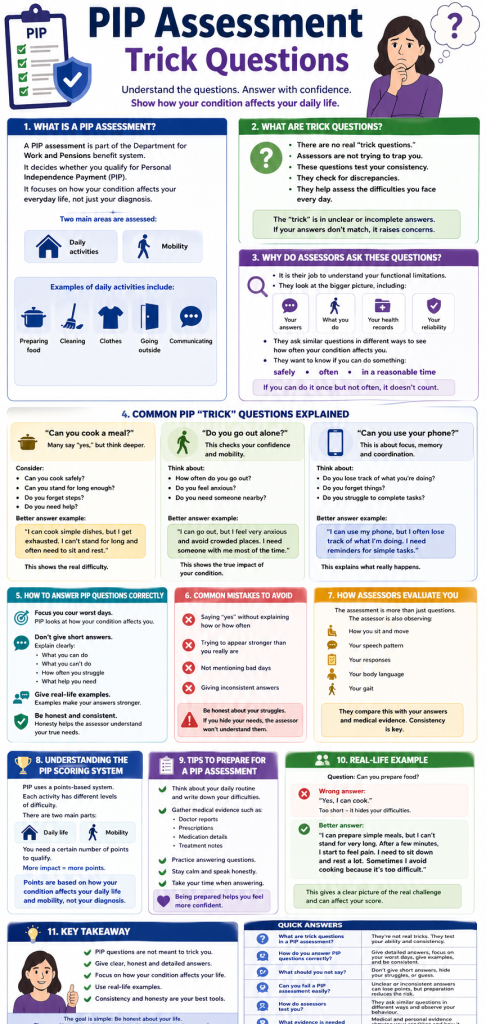
- Daily activities
- Your mobility
The most important thing is your functioning. This is not only about your diagnosis; it’s about your actual ability to live your daily life.
For example, having a condition is not enough. The assessor wants to know how that condition affects:
- Preparing food
- Cleaning
- Clothes
- Venturing outside
- communicating
The main goal of the approach is to convey the influence on real life.
What Are Trick Questions in a PIP Assessment?
To be clear, there are no “trick questions” in the traditional sense.
Assessors are not trying to trap you. However, they do ask questions that test your consistency.
As a result, they are called “trick questions.”
These questions are meant to:
- Examine your answers.
- Check for discrepancies
- Acknowledge the difficulties you face every day.
You could say, for example, that you can’t go very far. Later on, they might ask you about your shopping habits. If your answers don’t match, you should be worried.
The “trick” is therefore useless.
The main issue is that ambiguous responses may be misinterpreted.
Why Assessors Ask These Questions?
Understanding your functional limitations is the assessor’s duty.
They depend on more than just what you say. They take the big picture into account.
This includes:
- Your answers
- What you do
- Your health records
- Your dependability
They ask similar questions in different ways. This allows them to assess how often your sickness affects you.
Additionally, they want to know if you can:
- safely
- Often
- in a reasonable length of time
If you can perform something once but not often, it doesn’t matter.
Common PIP Trick Questions Explained
Let’s look at a few real-world examples. These seem like simple questions. On the other hand, people could misinterpret you if you react too soon.
“Can you cook a meal?”
Many respond with a “yes.”
But this can be misleading.
Think about it more. Can you cook safely? Can you stand for an extended period of time? Have you forgotten the steps? Do you need help?
An enhanced solution facilitates understanding of the problem.
For example:
“I can cook simple dishes, but I’m always exhausted. I’m not able to stand for too long. I often need to sit down and relax.”
The assessor is now aware of the challenges you encounter on a daily basis.
“Do you go out alone?”
This question evaluates your confidence and mobility.
Saying “yes” can imply that there isn’t a problem.
It’s possible, though, that you don’t spend much time outside. Or you’re anxious. Or you need someone nearby.
Describe the whole situation.
For example:
“I can go out even if I’m really anxious and avoid crowded places. I require company most of the time.”
This illustrates the true consequences of your disease.
“Can you use your phone?”
This appears to be an easy task.
But it has to do with focus, memory, and coordination.
You may be able to use your phone at times. But do you forget things? Do you have trouble doing housework?
Explain what actually happens.
For example:
“I can use my phone, but I frequently lose track of what I’m doing.”
I need reminders for simple tasks.
How to Answer PIP Questions Correctly?
This gives a clearer picture. How to Answer PIP Questions Correctly It’s important to avoid overanalyzing.
Providing a clear explanation is the key. You should always focus on your worst days. This is very important. PIP typically examines the effects of your disease.
Don’t give a brief answer.
Instead, be clear:
- Your ability
- What you can’t accomplish
- How often you struggle
- What help are you in need of?
Give real-world instances. These bolster your answers.
For instance, instead of saying:
“I have trouble walking.
Say: I have five minutes to walk. I was in so much pain after that that I had to give up. I therefore make an effort to avoid going out.
Your movement issues become quite apparent as a result.
Common Mistakes to Avoid
Common Mistakes to Avoid Many people lose points due to simple mistakes.
Here are some common ones:
- Saying “yes” without giving a reason
- Trying to project a stronger image than you truly possess
- Not bringing up challenging days
- Giving conflicting answers
You may need to sound optimistic. That makes sense. That isn’t appropriate in this case, though.
Be honest about your struggles.
If you hide your needs, the assessor won’t be able to understand them.
How PIP Assessors Evaluate You?
The exam consists of more than just questions.
The assessor is also watching you.
They look at:
- How you sit and move
- Your speech pattern
- Your response
- your body language
Your gait Your answers and medical data are compared to this.
If it doesn’t match, they might be dubious.
For example, if you appear at ease but pretend that you are unable to walk, people may notice.
This does not mean that they are judging you unfairly. They’re trying to paint a whole picture.
Being constant is the key.
Understanding the PIP Scoring System
PIP uses a points-based system.
Each task has a different level of difficulty. Each level has a unique point value.
There are two main sections:
- Daily life
- Mobility
You need to have a specific quantity of points in order to qualify.
You get more points the more your disease interferes with your life.
However, remember that points are not determined by a diagnosis.
They are based on how your disease affects your daily activities and mobility.
Tips to Prepare for a PIP Assessment
Being ready makes a big difference.
Think about your daily routine first. Write out your challenges. This helps you remember important facts.
You should also get medical records. This could include:
- Reports from doctors
- Prescription
- medications Treatment-related notes
Become at ease answering questions. This helps you stay calm.
In your remarks, try to be direct and honest.
Above all, be patient when responding to inquiries. Take your time, please.
Real-Life Example Scenario
Let’s compare two answers.
Question: Can you prepare food?
Wrong answer:
“Yes, I can cook.”
This appears to be a simple task. But it hides your problems.
Better answer:
“I am able to prepare simple meals. However, I can’t stand for very long. A few minutes later, I begin to experience agony. I spend a lot of time sitting down. Sometimes I avoid cooking because I think it will be too difficult.”
The assessor may now see the real challenge.
This disparity could affect the evaluation of your claim.
Emotional Support and Confidence
Feeling nervous is common.
Many folks feel overwhelmed during the process. That won’t cause you to fail.
Staying honest and prepared is the key.
You are not being given an exam. You are giving an account of your life.
Take a deep breath. Speak quietly. Discuss your reality.
Remember that the system’s goal is to understand your needs for assistance.
What Are Trick Questions in a PIP Assessment? (Quick Answer)
They’re not real tricks. These are thoughtfully constructed questions that evaluate practical abilities and consistency.
How Do You Answer PIP Questions Correctly?
In answer, you provide a detailed account of your situation. You focus on your worst experiences. One can give examples. You also keep your integrity intact.
What Should You Not Say in a PIP Assessment?
Don’t give brief answers. Don’t keep your problems to yourself. Avoid speculating. At all occasions, give a thorough explanation.
Can You Fail a PIP Assessment Easily?
You risk losing points if your answers are unclear or inconsistent. However, with careful planning, this risk is reduced.
How Do PIP Assessors Test You?
They ask similar questions in different ways and observe your behavior. They compare your answers with evidence.
What Evidence Is Needed for PIP?
You need medical and personal documents that show your condition and how it affects your daily activities.
Final Thoughts
PIP evaluation questions are not meant to trick you. They could appear difficult, though, if you are preparing.
The biggest mistake is providing brief or unclear answers.
Your goal is simple.
Be honest about your life. Show off your challenges. Give real-world instances. You enhance the assessor’s understanding of your situation by doing this.
And that leads us to a logical conclusion.