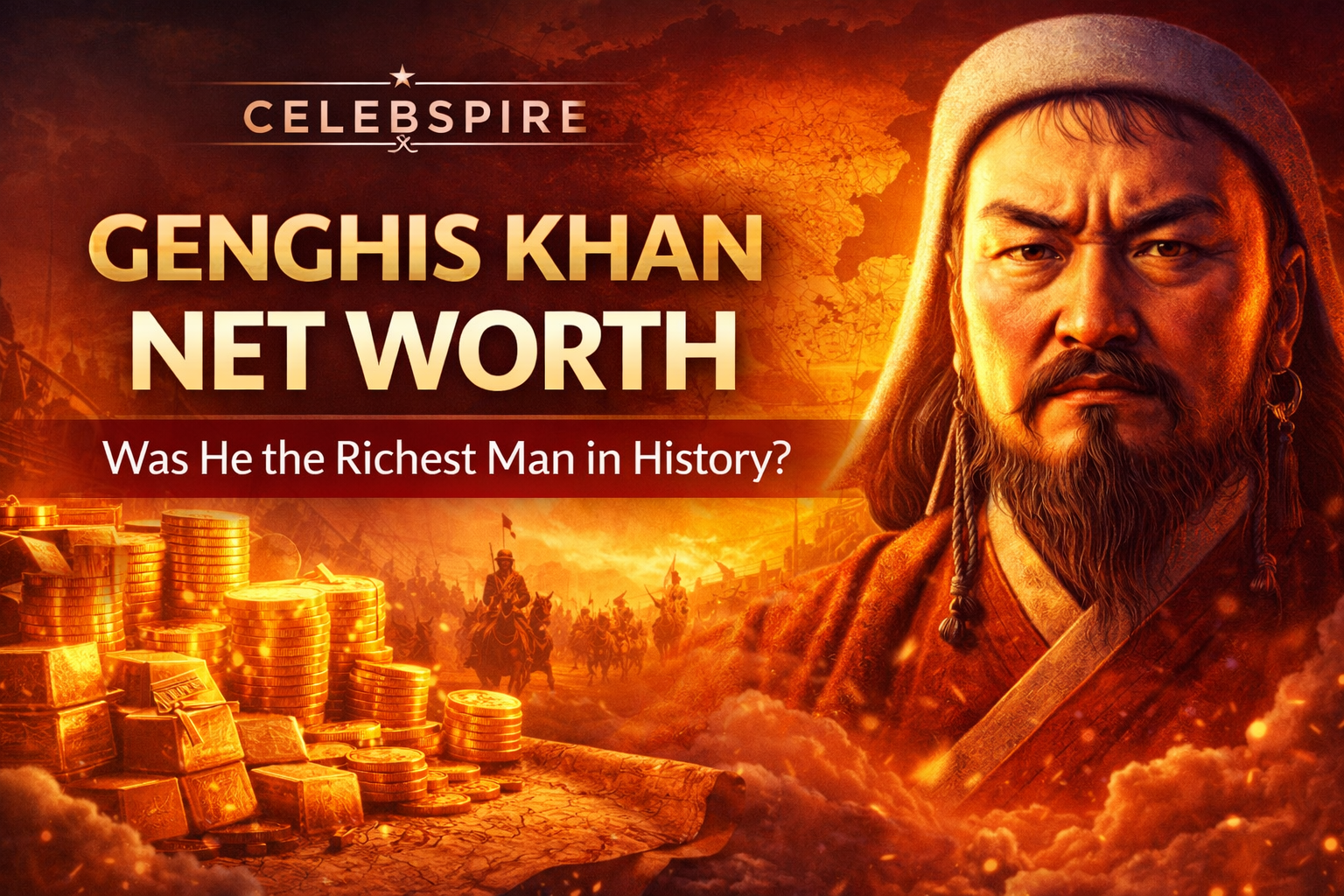
Who Was Genghis Khan?
The Mongol Empire was established in the early 13th century by the military commander and strongman Genghis Khan. He united the scattered tribes of Mongolia and turned them into a formidable military force. His rule changed the course of world history as it spread throughout Asia and Europe. But this is when the intriguing part begins. When someone discusses “Genghis Khan net worth,” they are describing an old reality using a contemporary notion. Confusion results from that.
What Was Genghis Khan’s Net Worth?
Let’s get right to the subject.
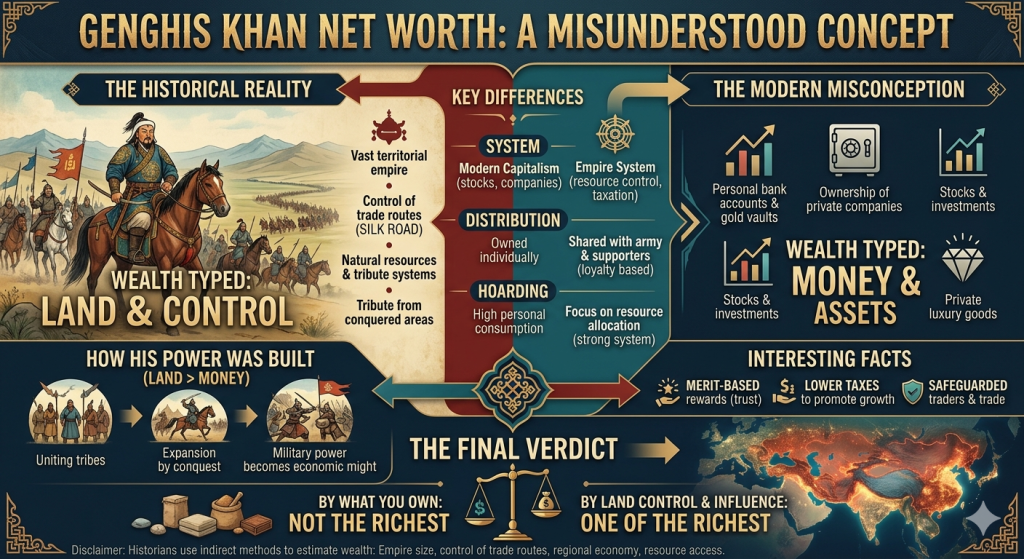
Genghis Khan had no net worth in the modern sense. He didn’t own a company. He had no stocks. Billions were not kept in gold vaults by him.
Therefore, it is deceptive to attempt to show a figure like €100 billion” or “-1 trillion.”
Rather, historians focus on his global reach, land ownership, and economic might.
Some estimates place the value of his empire’s resources at trillions of dollars if they were valued in today’s currency. However, that is not private wealth. Empires are the source of this money.
The Wealth of the Mongol Empire
The real source of prosperity was the empire itself.
The largest land empire in history was the Mongol Empire. It encompassed large portions of Asia and Europe. Genghis Khan was in charge of:
- Crucial trade routes, like the Silk Road
- vast areas of agricultural land
- Natural resources and tribute systems
This kind of wealth was not kept in banks. It came from economic systems that relied on resource control, taxation, and conquest.
Think about it this way.
A modern billionaire has belongings.
Genghis Khan controlled entire economies.
That’s a big difference.
How Genghis Khan Built His Power?
Genghis Khan was not a prosperous heir. He turned nothing into power.
He used strategy, discipline, and strong leadership to unite tribes. Then he expanded his military power through well-planned campaigns. With every victory, his economic might increased.
As the empire grew, so did its wealth.
He obtained:
- The accessibility of trading routes
- Tribute from conquered regions
- Control over cities and resources
This is how the growth of the empire directly produced money. Money had nothing to do with it. It has to do with influence and control.
Why Genghis Khan Did Not Hoard Wealth?
The most unexpected element is this.
Genghis Khan did not act like a conventional “rich man.”
He didn’t buy fancy goods or gold for himself. Rather, he concentrated on the allocation of resources. He distributed wealth to his army and devoted supporters. This reinforced his authority and fostered trust.
This is how his system operated:
- Merit-based rewards were awarded.
- The army’s wealth was dispersed.
- Loyalty was more important than wealth.
He was able to keep his empire together and powerful because to this strategy.
Therefore, even though he was in charge of enormous wealth, he did not actually own it.
How His Wealth Compares to Modern Billionaires?
Let’s now contrast him with contemporary individuals like Jeff Bezos and Elon Musk.
These people have quantifiable wealth. Their fortune stems from:
- Assets
- Enterprises
- Investing
The wealth of Genghis Khan was unusual. Aspect of the Modern Billionaire Genghis Khan Wealth Type:
Money & Assets Land & Control
Empire economics, capitalism, and system
DispersionOwned individually and shared
This reveals a crucial distinction.
Today’s wealth is monetary.
Wealth in the past is both territorial and systemic.
Thus, it’s not always accurate to compare them directly.
Was Genghis Khan the Richest Person Ever?
How you define “rich” will determine the answer to this question.
If wealth is based on what you own, Genghis Khan was not the richest person.
If wealth is based on land control, worldwide influence, and economic power, he might be one of the richest people in history.
Some historians say he was even more powerful than any rich person alive at the time.
But calling him “the richest man ever” would be misleading. It brings together two different systems of wealth.
How Is Historical Wealth Calculated?
This is the hard part.
Historians cannot figure out exactly how much money ancient kings and queens had. Instead, they use indirect methods:
- How big the empire is
- Control over trade routes
- The economy of the region
- How easy it is to get resources
While not precise, these components facilitate the assessment of historical wealth.
For example, controlling the Silk Road meant controlling trade between countries. That alone gave them a lot of economic power, even though they didn’t have money in the modern sense.
Interesting Facts About Genghis Khan’s Wealth
Genghis Khan had a distinct approach to wealth.
Building a solid system was more important to him than amassing wealth. His empire brought economic stability to previously fragmented areas.
Here are some intriguing observations:
- He safeguarded traders and encouraged trade.
- To promote growth, he lowered taxes in several areas.
- He promoted economic and cultural interchange.
Not only did these practices benefit him personally, but they also increased the empire’s overall riches.
Final Thoughts on Genghis Khan Net Worth
What is the ultimate response, then?
It is impossible to put Genghis Khan’s wealth in monetary terms.
He didn’t live in a world of stock markets or bank accounts. His world was one of economic might, military might, and land ownership.
In terms of personal fortune, he had relatively little.
He was in charge of one of the richest systems in history when it came to empire wealth.
Because of this, the subject of “Genghis Khan net worth” is both intriguing and misinterpreted.
To put it plainly, he wasn’t the wealthiest man in terms of money.
However, very few individuals in history are comparable in terms of power and worldwide effect.