The expression “which ear is the gay ear” has been around for decades. It’s a common theme in conversations about men’s jewellery, fashion icons and LGBTQ culture. But there is no obvious significance behind it as once supposed.
Most ear piercings today are fashionable. But in the past, there were occasions when the ear a man had pierced was occasionally assigned societal implications. This spawned myths, assumptions and confusion that still exist on the internet today.
In this essay we will discuss about the story of the “gay ear” idea, where it comes from and why it doesn’t really matter anymore in today’s fashion culture.
What Does “Gay Ear” Mean?
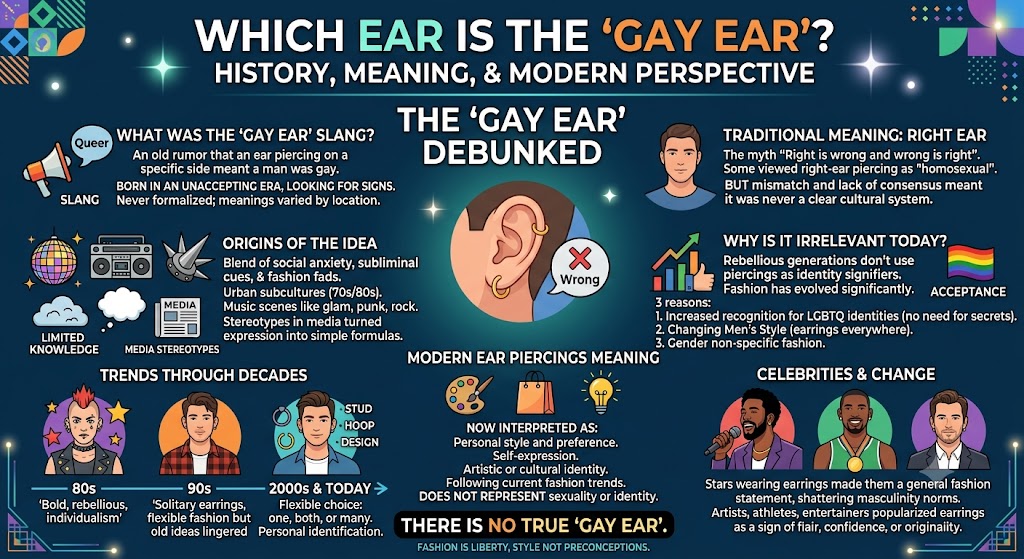
There was a slang back in the day that a man with one pierced ear was queer . The name was “gay ear” . It was not a law, not a universal code also it was more of a rumor in the society which circulated in various circles.
It was a concept born in a time when being LGBTQ was not something widely accepted. People would sometimes look for little clues to get a sense of who someone was. Added ear piercings to the guessing game.
But it was never formalized. It was different in the different places. In one tribe, people believed one thing, in another community people thought something quite different.
So when people question “which ear is the gay ear” the honest answer is simply this, there’s no true “gay ear”.
Which Ear Was Traditionally Called the Gay Ear?
In 1970s-1990s western pop culture some people used to say that males who pierced their right ears were homosexual. The result was the famous phrase:
“Right is wrong and wrong is right.”
This comment was echoed in many circles, sometimes in jest, sometimes in earnest. But this was not the usual case. It never got very many believers.
In some places it was the other way round. Some saw no meaning in it. And that mismatch means it was never really a cultural system.
But the stereotype was very much taken care of. It was in youth culture, in the periodicals, in the lingo. It generated a confusion throughout time of what a left and a right ear piercing meant.
For most people today it’s not a fact, it’s a myth.
Where Did This Idea Come From?
The “gay ear” theory was a blend of social anxiety, subliminal cues, and fashion fads of decades past.
Before the general acceptance of LGBTQ persons, occasionally the inconspicuous indicators were used to identify an identity in organizations . Clothing choices, hues, earrings and other accessories.
In this setting, the meaning of ear piercing shifted. The earringed man was already breaking the established conceptions of manhood. So society tried to decipher the code of what they determined.
Important influences were:
- Urban subcultures of the 1970s and 1980s
- Music scenes such as glam punk and rock dress
- Limited public knowledge of LGBTQ identity
- Media stereotypes that turn personal expression into simple formulas
These qualities combined to produce stories that were not actually consistent, yet travelled swiftly.
It is worth remembering that no mainstream LGBTQ organization ever regarded ear piercings as a sign of identification.
Is the “Gay Ear” Idea Still Relevant Today?
The notion of a “gay ear” is mostly a thing of the past in the culture of today. “Rebellious” generations do not use ear piercings to signify a person’s sexuality.
Fashion has evolved a lot. And today earrings are chosen for their elegance, comfort and expression of self.
The original reading no longer works for three main reasons:
First, many communities are increasingly willing to recognize LGBTQ identities. They don’t need secret signs anymore to know who they are.
Second, men’s style has changed. Today, earrings are worn in business, entertainment, sports and street dress.
Third, the fashion world is gender non-specific. Many of the old rules have been stolen from us by social media and celebrity influence.
This change has meant the meaning of ear piercing has become more about personality than sexuality.
Ear Piercing Trends Through the Decades
Men’s ear piercing fashions have changed a lot. Every decade new meanings, but less prejudices too.
Earrings of the 80s were huge and rebellious. Musicians and actors used them to set themselves apart. Piercings have become a symbol of individualism in punk and rock cultures.
Trends grew prominent. 1990s More men began to wear solitary earrings. Fashion was changing fast already, but there were still those who clung to the old ideas of significance.
Things became more flexible from the 2000s on. Piercings, studs, hoops and simple designs – they all became a regular.
“Today, men’s ear piercing trends are about personal identification. “Some people choose an ear and some do both.” Some have plenty of piercings. There is no quick and easy rule.
Celebrities and Men’s Piercing Trends
Celebrities have had a major impact on the way people think about ear piercings. Soon, as artists, athletes and entertainers began to wear earrings openly, the earrings became a fashion statement not a symbol.
Pop singers, rap artists, and Hollywood celebrities made guys in earrings okay. Their piercings made a statement, showing how piercings may be a sign of flare, confidence or originality.
The athletes contributed too. Several wore earrings in interviews and public appearances, shattering conventional ideas of masculinity.
So, it became a general fashion statement, rather than a code.
What Ear Piercings Mean Today?
All sorts of different things than what they used to mean in the days of ear piercings. In modernism they are interpreted as:
- Personal style and preference of clothing
- Art as self-expression
- Artistic or cultural identity
- Following the current fashion trends
They do not represent sexual orientation or identity.
And gender expression is more diverse. Fashion is considered adaptable by many today. This means earrings aren’t restricted by any gender limitations or society codes of the past.
Today’s ear piercings are less about who someone is, and more about what someone wants to look like.
Why Fashion Symbols Change Over Time?
As culture changes, so do fashion indicators. What is meaningful may over time become meaningless.
Old preconceptions against ear-piercings vanished because:
Today’s communication has broken the societal rules of secrecy. It’s a world where the internet allows us to exchange fashion ideas everywhere.” Styles are more global, so cultures are transferred.
The young challenged the old ideals. They chose individualism over labels.
Fashion is not static, it is continually evolving with culture. Body alteration including piercings, tattoos and styling decisions are an expression of personal originality and not secret meanings.
Common Myths About Ear Piercings
Many of the concepts of ear-piercing and sexuality still reign. These concepts are not reality based but ancient assumptions.
First, let’s bust a few myths:
- Myth: When the right ear is pierced, the person is always homosexual
The fact: There is no such widespread standard. - Myth: Straight boys = left ear piercing
Reality Ear choice is not really relevant - Myth: Ear piercings are a representation of who you are or what you believe in
Reality: Mostly, they mean style decision.
They were not myths of scientific or social fact but of cultural misconception.
Why Men Choose One Ear or Both?
There are several reasons why guys get their ears pierced. Others prefer one stud for a simple style.” Others prefer symmetry and pick both. Some are fashion-oriented. Some are based on family custom or culture.
There are no right or wrong decisions. Style is comfort. It is identity.
Fashion is liberty in today’s world. This is what makes the culture of ear piercing go different ways.
Masculinity, Identity, and Fashion Evolution
Modern civilization has altered a lot in manliness. Previous generations had guidelines on how men should be dressed. Earrings were sometimes viewed as rebellious or odd.
Those boundaries are fluid now. “Men can wear jewellery and play with styles and express personality without being labelled.
This points to a larger societal transformation. Fashion is no longer of fixed categories. Instead it encourages individuality and self-expression.
Ear piercings are one element in that growth. Now they don’t have any hidden meanings. They are merely a reflection of style decisions.
Do Ear Piercings Still Represent Sexuality?
Not in most modern situations, no. Ear piercings aren’t a reliable or significant indicator of sexuality.
Sure there are still some that believe in these old stereotypes but these views are not reflected in modern fashion culture or LGBTQ communities.
Sexuality is private, and not to be defined by accessories. Such connotation is too common and too different for ear piercings.
Final Thoughts
So which ear is the gay ear?
The real explanation is: there is no “gay ear.”
The concept stemmed from ancient stereotypes that don’t fit modern culture anymore. People used to try to assign meaning to left and right ear piercings, but those meanings were never consistent or universal.
Today, ear piercings are just another way to display fashion, not identity. They represent inventiveness, personal taste and originality.
Fashion is ever changing, and so is society’s perception of identity. It doesn’t matter which ear someone pierces. Now what matters is how they choose to express themselves.
At the end of the day, ear piercings are about style – not preconceptions.